Alice Roosevelt never threw anything away. Her house on Massachusetts Avenue filled up over sixty years with souvenirs from her travels, photographs, trophies from her father’s expeditions, and stacks of books. Visitors left with the sense that every object had a story, and that she’d be happy to tell it if you stayed for another drink.
We took that as a design brief.
The art collection inside The Beacon was curated by Eaton Fine Art of Austin, Texas, in collaboration with Wimberly Interiors. It is built around two subjects: the life of Alice Roosevelt, and the city she took by storm. Here is a guide to what you’ll find, and where.
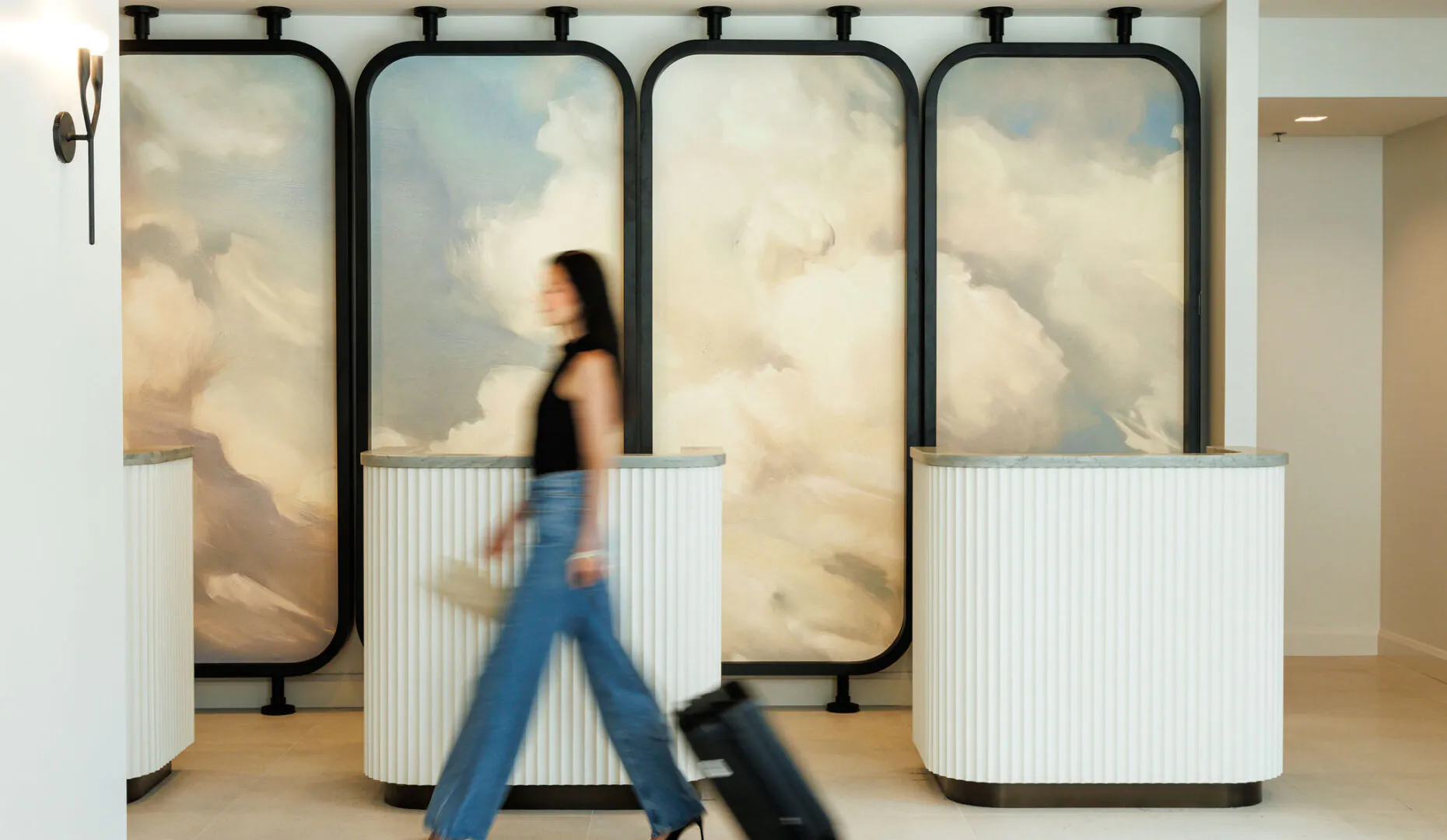
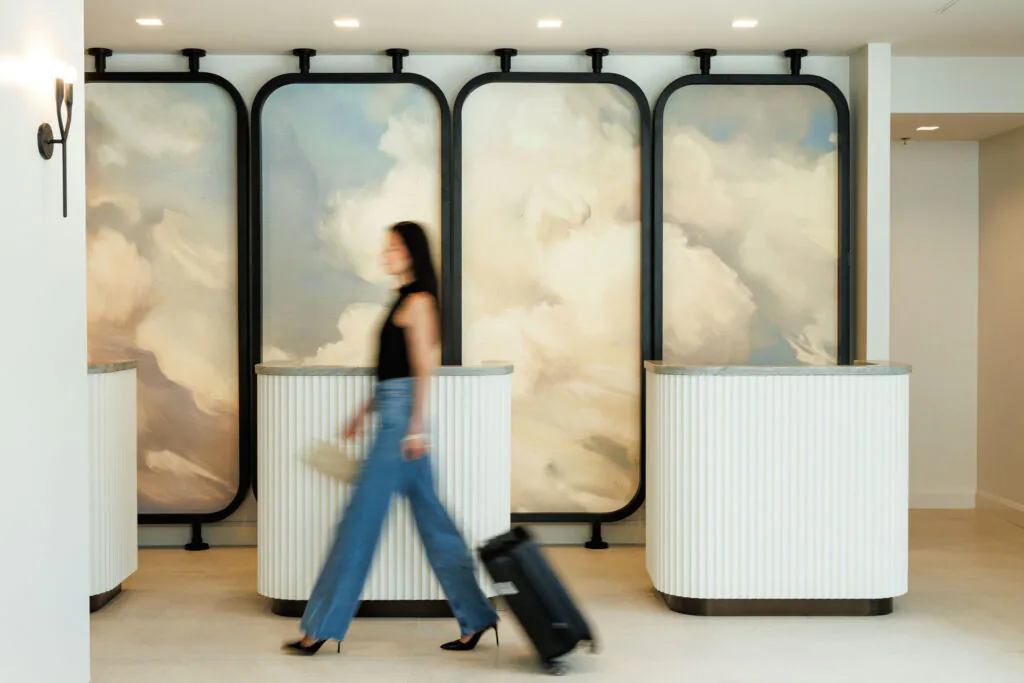
The first piece most guests notice is behind the front desk. Cloud Panels is a run of painted skies set into the registration wall, designed with Washington’s fall weather in mind: crisp, temperate, and a little dramatic.
The lower lobby is where Alice is most present, sometimes literally.
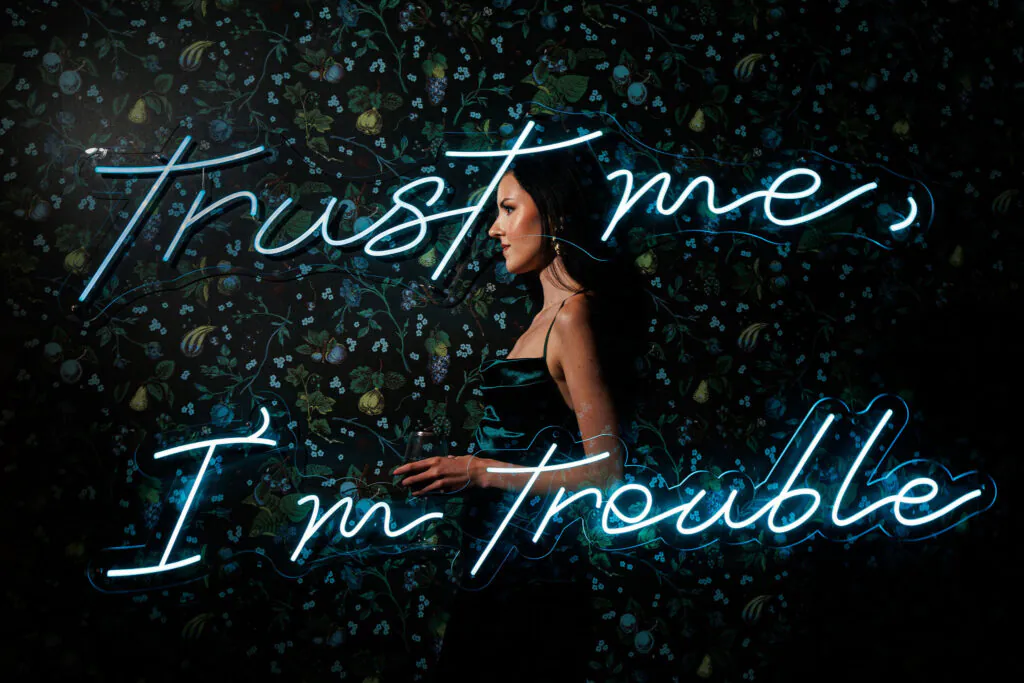
Start with the sign. A custom neon piece in glowing turquoise script reads “Trust me, I’m trouble.” It is less a welcome than a disclosure, and a nod to Alice’s rebellious spirit.
Newspapers of her day called her “Princess Alice,” and a pale shade of blue took her name. That shade, Alice Blue, runs through the collection. Alice Blue, Butterfly Bloom places blue morpho butterflies around a dark, painterly still life. Framework, by the Seattle artist Elle Hanley, shows a woman in a pale gown holding an ornate empty frame in a blue-dusk landscape.
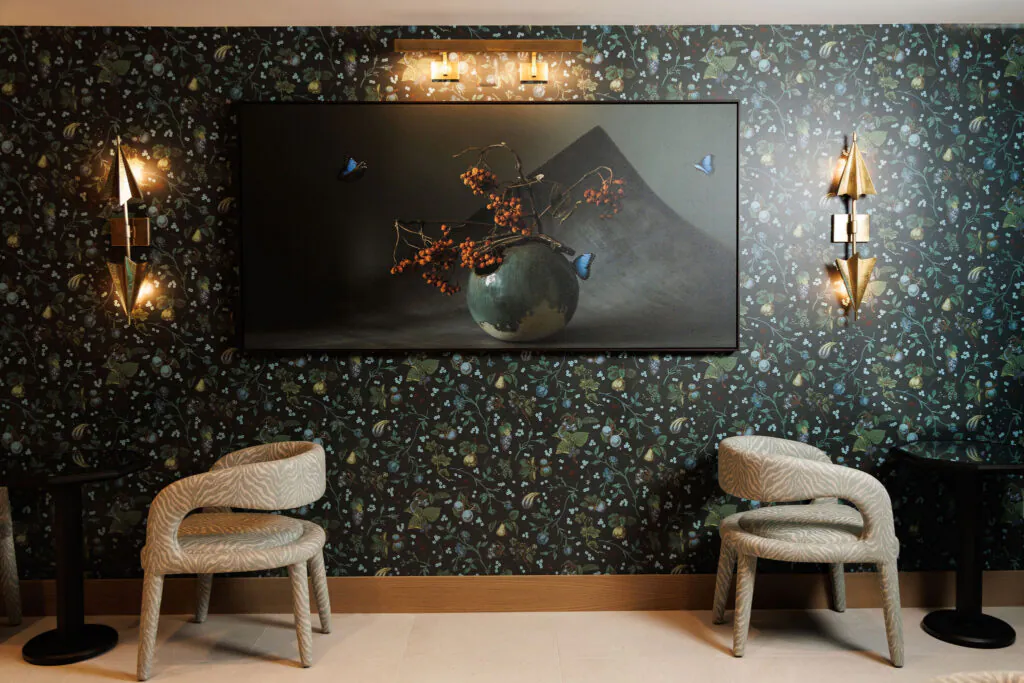
Look for Emily Spinach, a moody green still life named after the garter snake Alice carried around the White House. She said it was as green as spinach and as thin as her Aunt Emily. Fruits of the World nods to her own description of her appetite for life. Her father said she was “running riot.” She called it “eating up the world.”
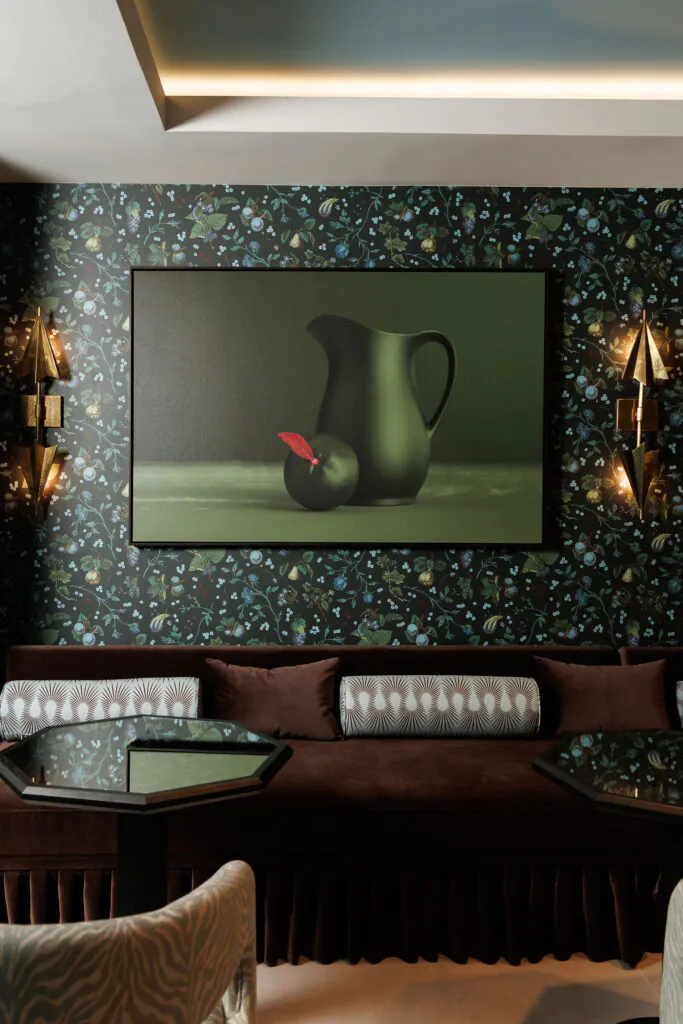
The lower lobby also holds three photographs by Miguel Vallinas Prieto of Madrid: No 17, No 18, and No 77. In each, a figure’s head is replaced by something else, including a burst of letter tiles, a cloud, and a constellation of gold stars. Surreal, funny, a little unsettling: they fit right in.
The corridors slow the pace. Barcelona-based Karenina Fabrizzi contributes From Fear to Flowers, a profile silhouette filled with blooms, and De Occulta Philosophia Dripping Flowers, a darker piece where white paint runs from a bouquet. Anja Schütz, a photographer from Turners Falls, Massachusetts, contributes an untitled still life from her Still-Life series. In it, a magnolia drops its petals into a turquoise bowl. London artist Stephen Doherty’s Fallen 02, from his Gratitude Blooms series, paints three fallen petals in deep wine and cream.
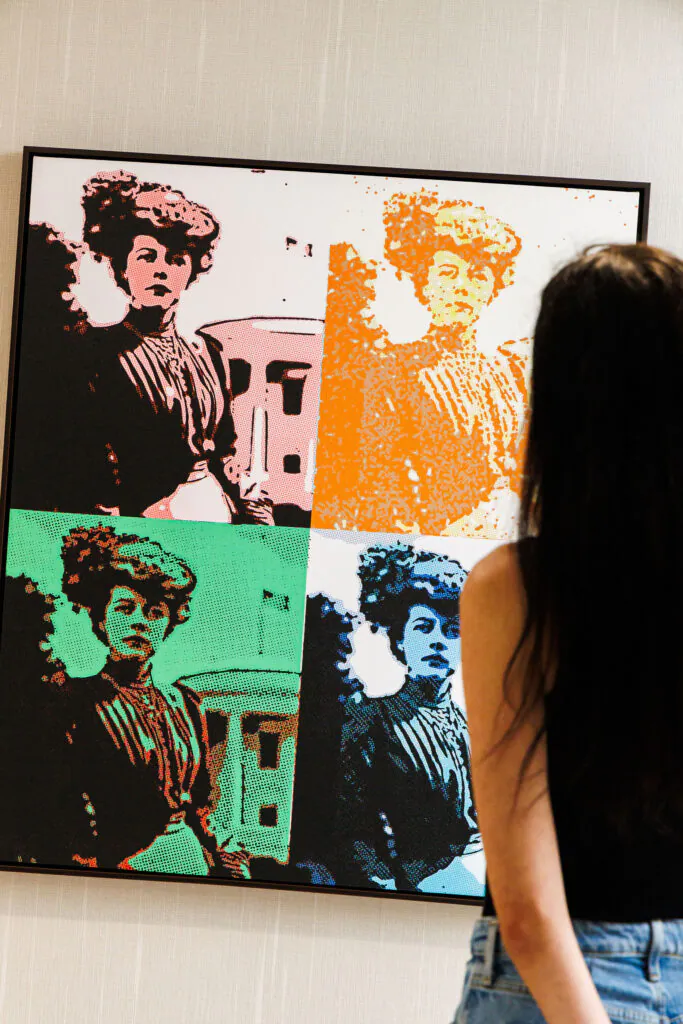
Two pieces greet you before you reach the ballroom doors. Popart Alice gives her the four-color Warhol treatment, repeating a White House-era portrait in pink, orange, green, and blue. Beside it hangs Hanley’s butterfly effect: a woman in orange floating beneath a swarm of monarchs. The curators chose it partly for its name, since one small, persistent personality can change a great deal over time. Alice was a case study.
Inside, the collection turns to this part of Washington.
Scott Circle Landmarks sets General Winfield Scott’s equestrian statue, a few steps from our front door, against blocks of teal and midnight blue. Enveloped by Oak layers a pattern of leaves over the Samuel Hahnemann Monument on the east side of the circle. Aerial Dupont reduces Dupont Circle to a ring and its spokes, a nod to the traffic circles that shape the city. Row Houses on Dupont Circle and Circling the Fountain complete the walk west.
Other pieces follow the water and the seasons. A Clear Reflection is a sweep of green inspired by the Potomac. A Dusting of Flowers and Ferns honors the year-round Sunday farmers market at Dupont Circle. Don’t Forget to Eat Up the World is a soft wash of Alice Blue landscape, and a gentle instruction.
Contemporary voices fill out the room: Alyson Fox of Spicewood, Texas, with Spirit and Corsage 3; Novi Lim of North Carolina with Love Story II; and Chaos Theory, an abstract companion to the butterfly effect hanging just outside the doors.
Depending on where you stay, you might wake up to Social Butterfly, a portrait of Alice in her signature blue, surrounded by flowers and butterflies. Or you might find Eating Up the World and Running Riot, her two famous phrases in carnival-bright letters. Other rooms have Washington scenes: Blossoms on Scott Circle, Rose Garden, and Traffic Circle.
Others hold abstract work by Synnöve Seidman of Montreal (Cake or Pie), Ana Žanić of Geneva, Illinois (Blush Nebula 11), Shina Choi of San Ramon, California (Pink Aura Bloom and Alpine Lily), Kiah Denson of Austin (Retreat, Resurface), and Glasgow’s Baldvin Ringsted, whose All Summer in a Day slices a painting of roses into vertical strips.
Look around before you unpack. You may be sharing your room with a rebel.
The collection is meant to send you back out the door curious. The neighborhood makes that easy. The Phillips Collection, America’s first museum of modern art, is a short walk west past Dupont Circle. The National Geographic Museum of Exploration is a couple of blocks away. Our Dupont Circle and Embassy Row guide can help you plan the walk.
Alice spent her life collecting the world and bringing it home. We have done the same thing in reverse: brought her home, and invited the world in. Book your stay and come see what’s on the walls.